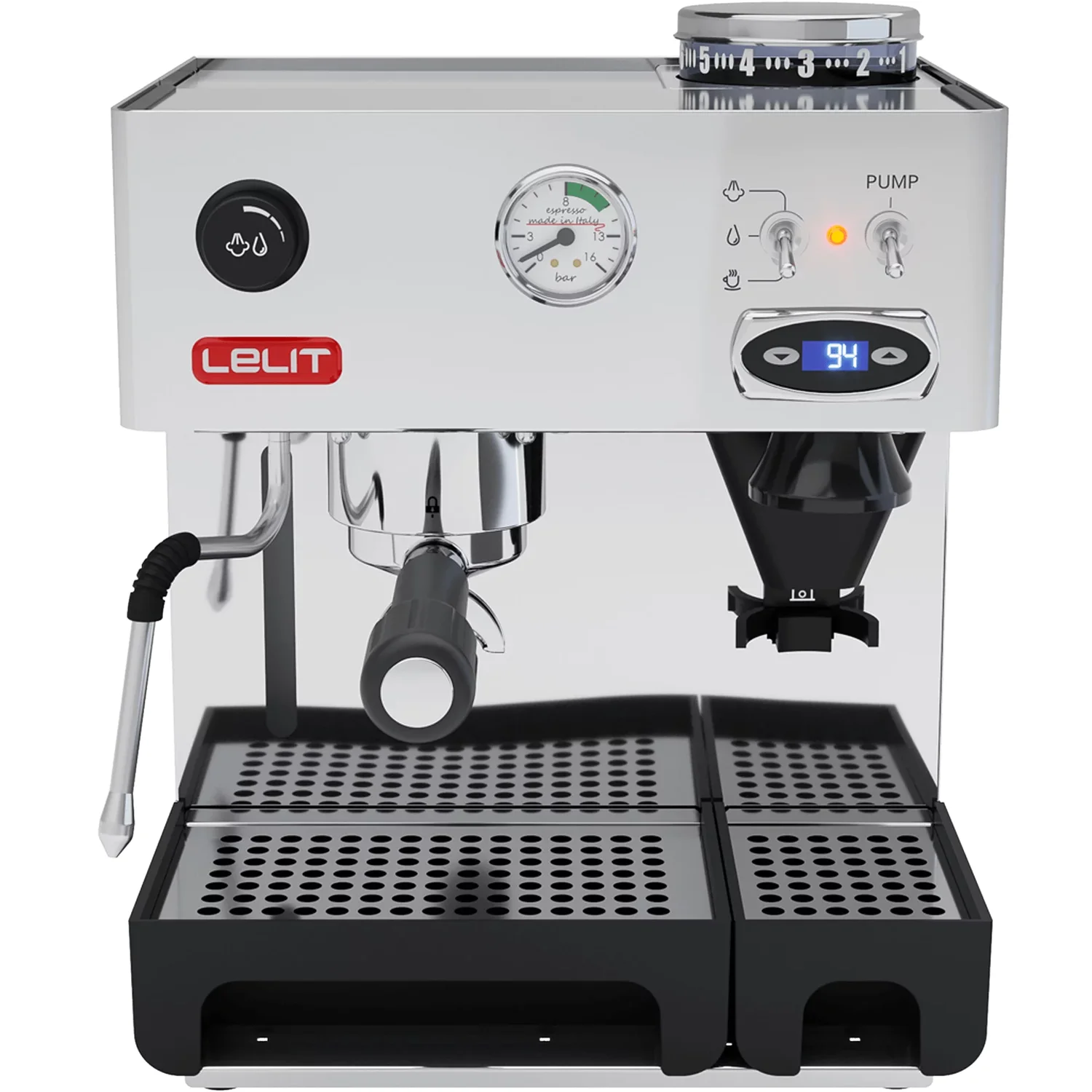
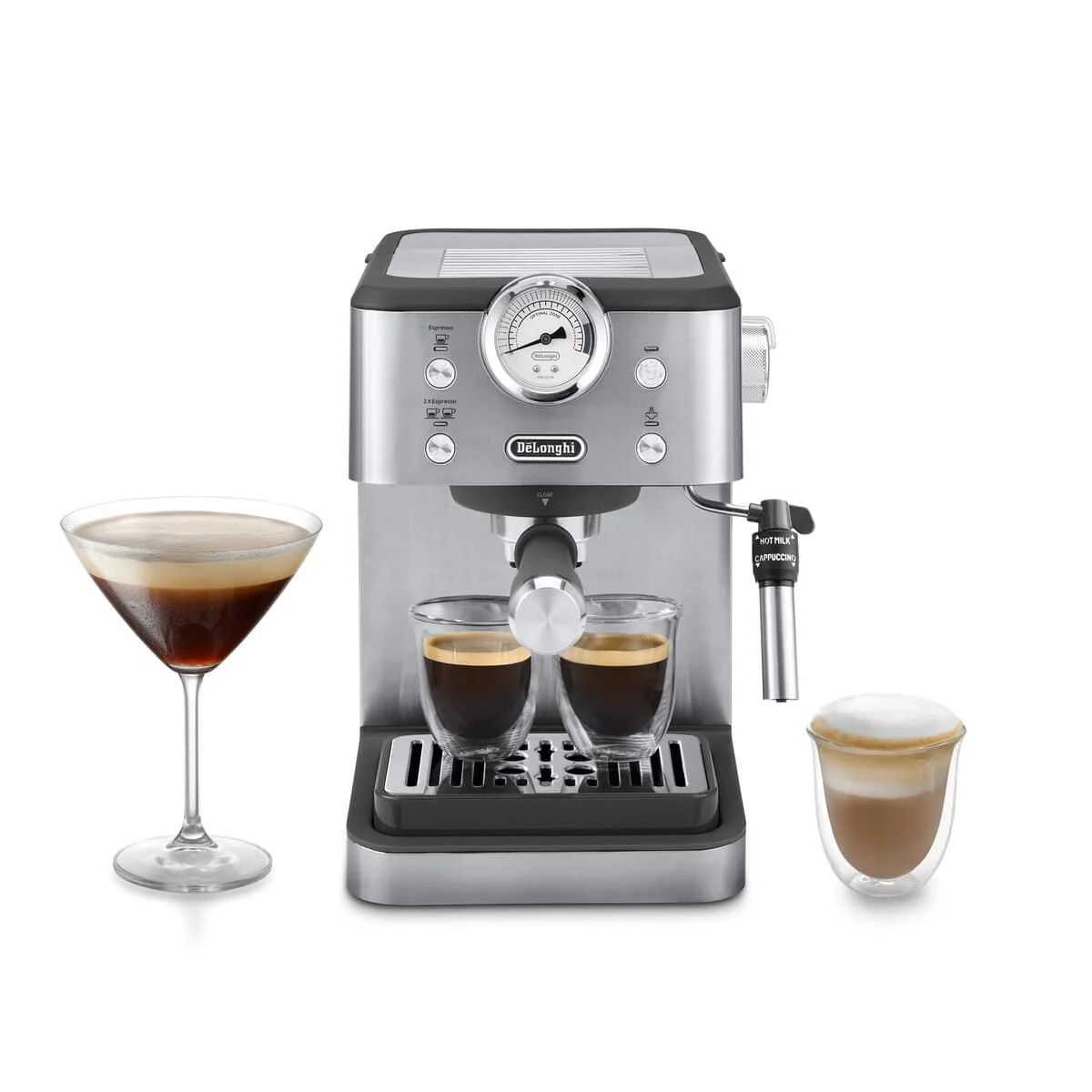
Steam wand: panarello or professional wand
A panarello emulsifies for you and produces a puffy foam. A bare wand does nothing on its own, and precisely for that reason it allows microfoam.
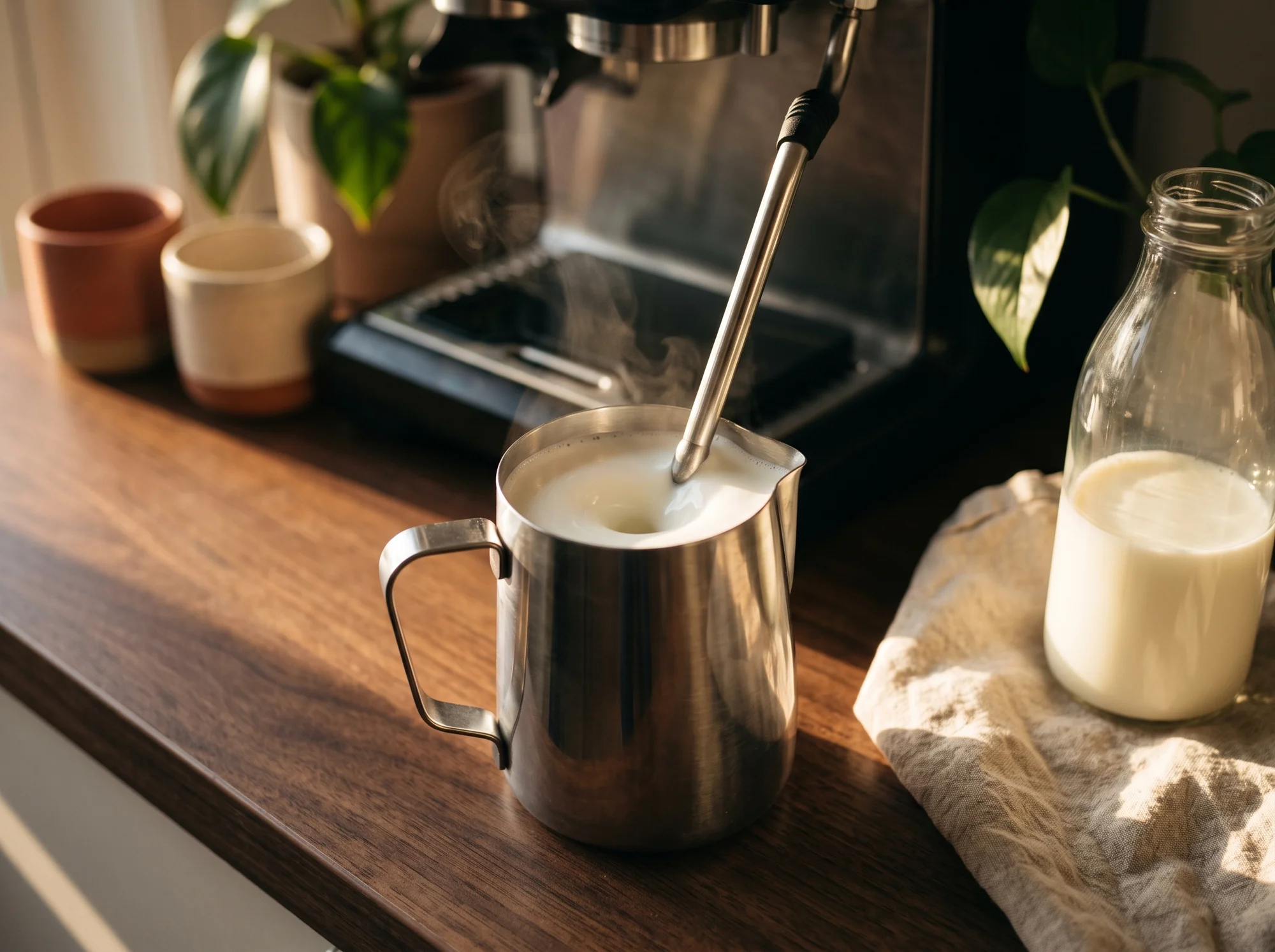
Frothing milk is a matter of air and of vortex, in that order and in two distinct phases. First you introduce air into the milk, in a measured amount; then you stop, and use the force of the jet to spin the whole liquid on itself until the large bubbles break into very small ones. The first phase builds volume, the second builds texture. If the second never happens, what is left is a foam of large bubbles that separates from the milk in half a minute.
The attachments found on machines completely change the control you have over these two phases.
The panarello
It is a plastic or metal sleeve covering the wand, with a small hole in its side. Steam leaving the tip creates a depression inside the sleeve and draws air in through that hole: the emulsion happens inside the sleeve, before the steam ever meets the milk.
Its virtue is that it works almost by itself. Submerge, open the steam, wait: the foam rises. For anyone who wants a cappuccino without learning anything it is the honest solution, and that is why it is found on entry-level machines.
Its limit is structural. Air enters continuously and in quantities you do not govern, and the sleeve obstructs the vortex — the milk does not spin, it is inflated in place. What comes out is an abundant, dry foam with visible bubbles, the kind that stays on the spoon. It is fine on a traditional cappuccino with cocoa dusted over it; you will not draw anything on it, and under the foam the milk stays liquid and separate.
Let us add the thing nobody mentions: the panarello has to be taken off and washed, because milk gets into that hole and stays there.
The bare, or professional, wand
A tube with a tip carrying one or several holes, and no attachment. It does nothing on its own: you introduce the air, holding the tip just under the milk's surface for as long as you decide — that steady hiss you hear in cafés — and then you sink it deeper, at an angle, to create the vortex that breaks the bubbles.
The achievable result is microfoam: milk and air become a single glossy, dense cream that pours and stays bound. It is what allows latte art, but above all it is what tastes of milk rather than of froth.
The price is that it has to be learned, and the first attempts will be bad. The number of holes in the tip changes its character: few holes are slower and more forgiving, many holes are fast and demand a suitable jug and steady hands.
There is also a variant worth knowing: cool touch wands, insulated, that do not burn on contact. They do not change the foam, they change how often you scald yourself. And they need cleaning immediately all the same: dried milk inside a tip is hard to remove.
Automatic wands
Some machines have a wand with a probe that froths milk to a set temperature and stops by itself. They remove the human variable in both directions: no disasters, and no truly excellent microfoam either.
The three approaches, on the things that matter
| Panarello | Bare wand | Automatic wand | |
|---|---|---|---|
| Who decides how much air | The attachment | You | The machine |
| Type of foam | Puffy, visible bubbles | Microfoam, if you can make it | Consistent, medium |
| Learning curve | None | Real | None |
| Latte art | No | Yes | No |
| Cleaning | Must be dismantled | A wipe and a purge | Automatic cycle plus manual |
What our catalogue says
As of 7 September 2026, of the portafilter machines that declare a wand type (30 entries), 26 have a bare manual wand, 2 an automatic wand and 2 a panarello.
Once again this is the effect of the segment, and this time an extreme one: the panarello is the entry-level attachment, and the entry level is thinly represented in this catalogue. In the real market panarellos far outnumber bare wands.
How to steam, with each
With a bare wand: cold milk, cold jug, filled a little past a third. Purge before you start. Tip just under the surface, steam full open, hold the hiss for a few seconds while the volume grows; then sink and tilt, and let it spin until the jug becomes hot against your palm. Close, tap the jug on the counter to break any surviving bubbles, swirl. Purge again and clean the tip immediately.
With a panarello: submerge the whole sleeve, open the steam, move almost nothing and stop when the volume is enough. Do not look for a vortex, you will not get one. And take the sleeve off to wash it, every time.
If milk interests you more than the machine does, the catalogue also has dedicated milk frothers, which solve the problem by another route.