Cleaning the group, the portafilter and the milk system
Coffee leaves fats, milk leaves proteins. They are different kinds of dirt, which call for different products and above all different frequencies — and the milk system is the one that always gets neglected.
A coffee machine gets dirty in two completely different ways, and confusing them is why routine maintenance so often gets done badly. Coffee leaves fats — the oils that settle on the walls of the group, the portafilter and the gaskets. Milk leaves proteins and sugars, which dry inside a narrow tube into a crust that plain water struggles to dissolve. They need different products, and above all different timing.
The group and the portafilter: dirt that builds up slowly
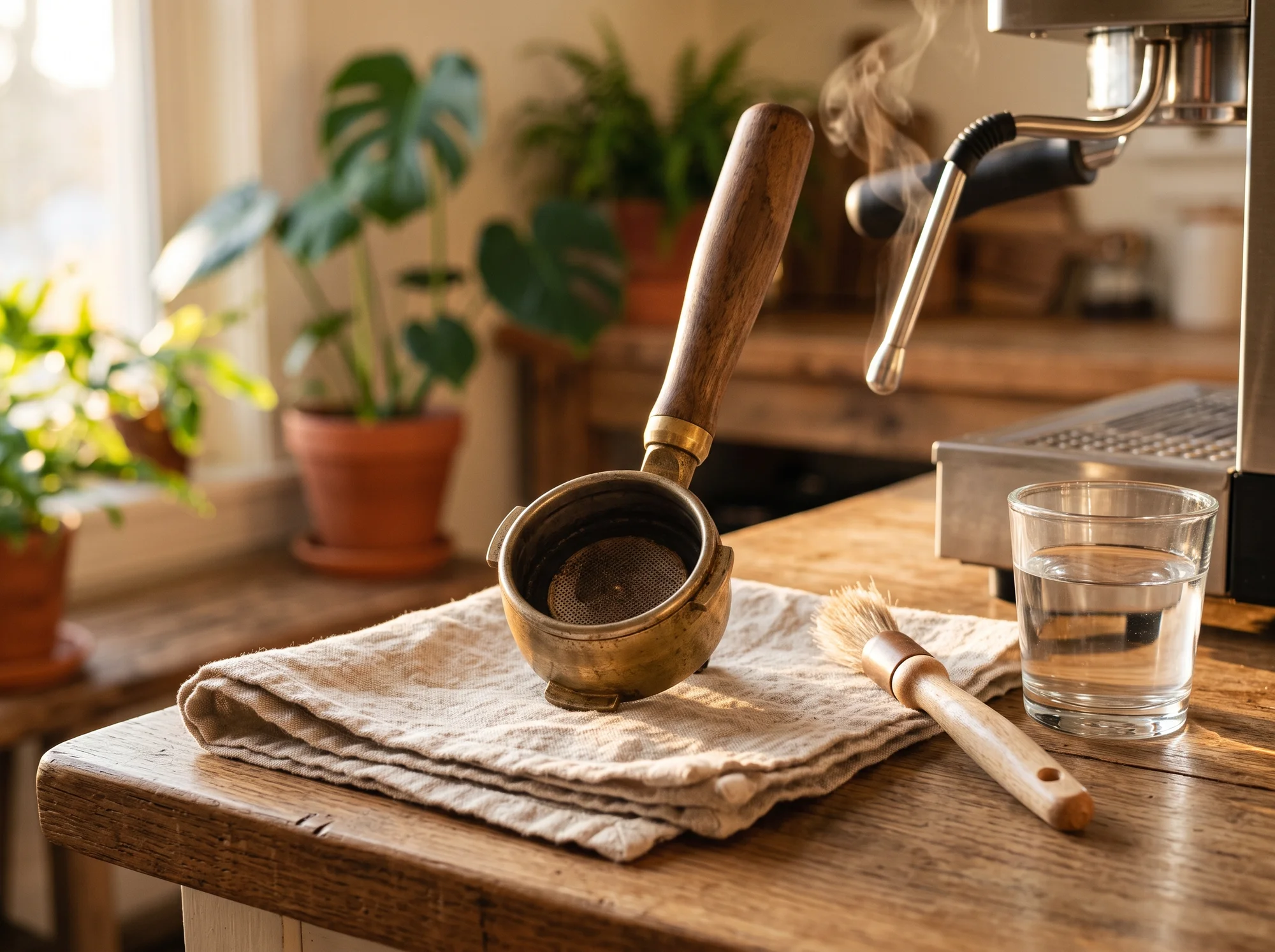
Every extraction leaves a film of coffee oils on the walls of the group and on the portafilter's filter basket, which turns rancid over time. It is not dirt you see straight away — the coffee can still look normal even when the group is already dirty — but it is dirt that changes the flavour: the oxidised oils add bitter, rancid notes on top of the extraction's own, and they are indistinguishable from a grind or dose fault unless you know there is a group to wash upstream.
The remedy is backflushing: with a blind filter in place of the perforated one, water — or a specific cleaning solution — is pushed backwards through the group, using the pump's pressure to drive residue upward instead of downward. It is a gesture that portafilter machines allow by design; bean-to-cup machines hand the same task to the removable brew group, when there is one, rinsed under the tap.
The milk system: what gets neglected, and why it is a mistake
Here physics works against anyone who puts it off. Milk left in a narrow, lukewarm tube dries within minutes into a protein film that no longer dissolves in plain water. Waiting "until this evening" means washing a crust instead of a fresh residue — and inside a passage the steam has just left warm and damp, that crust is also an environment where bacterial load grows faster than anywhere else on the machine.
That is why manufacturer manuals are explicit about a point concerning the gesture, not the product: the milk circuit has to be rinsed immediately after use, with a burst of steam or hot water run through empty, before any more thorough wash with detergent. The specific detergent is for the dirt that builds up regardless in the narrowest passages; it does not replace the immediate rinse.
The products, and what they declare
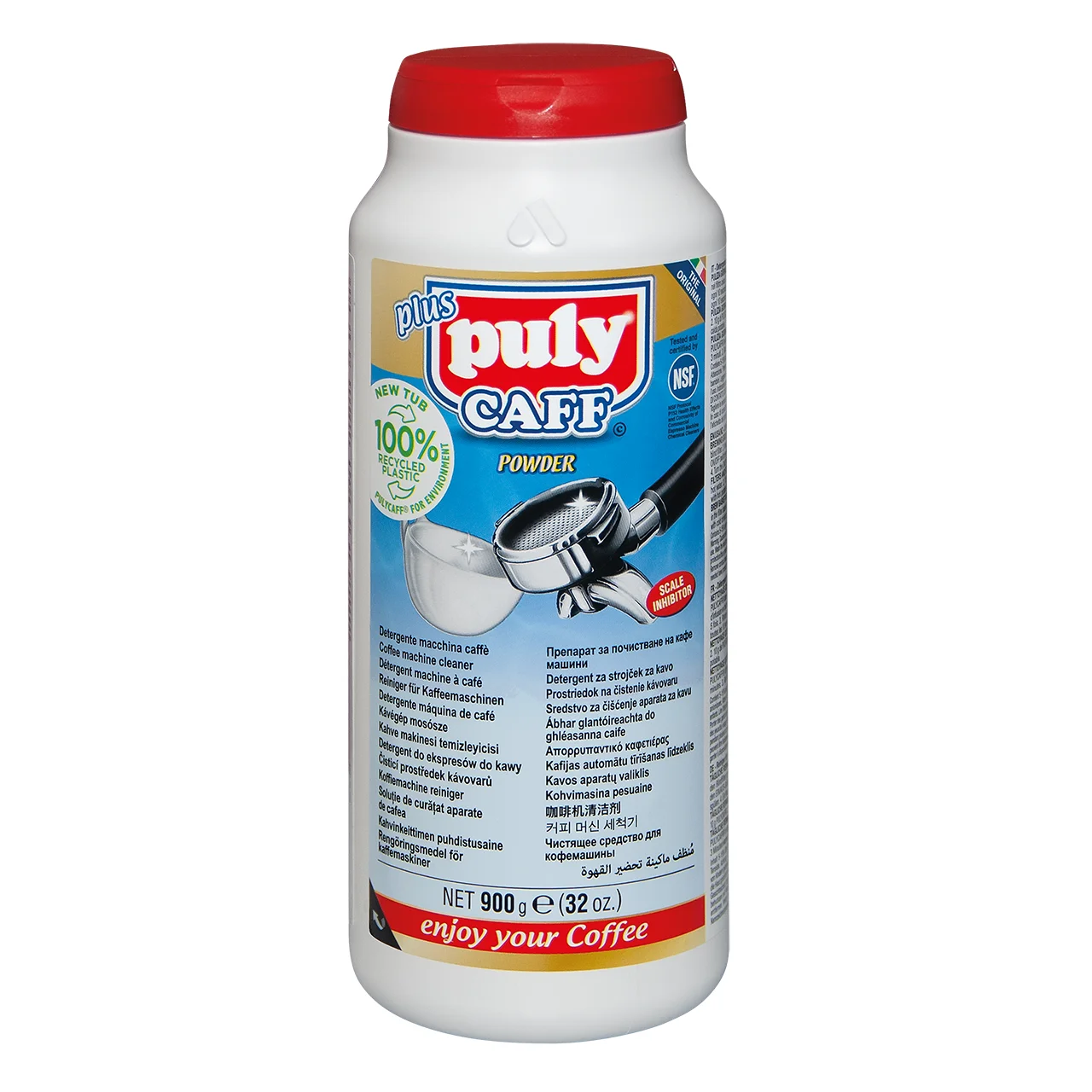
As of 7 September 2026 the cleaning products in our catalogue number 6: formulations for the group, the solenoid valve and the portafilter; one specific to the steam wand and the cappuccinatore; one for the grinder's burrs; and generic products for descaling and degreasing the milk circuit. They are not interchangeable — a product meant to dissolve coffee oils is not calibrated for milk proteins, and vice versa — which is why a maintenance kit almost always has more than one item in it.
On food safety, the data is clear where declared: the two catalogue products for which we have the certification both declare it, referencing a US health-protection body that verifies the raw materials used. It is information about what stays in contact with the parts that later touch the coffee or the milk, and it is the first thing to check for a product meant for the group or the milk system.
What our catalogue says
The grinder comes into this discussion for a reason that gets forgotten: even there, where only dry coffee passes, oils and very fine powder remain and turn rancid inside the grinding chambers. Among the 6 catalogue products there is one specific for this, in the form of absorbent crystals — a reminder that maintaining a grinder is not just about adjustment, it is also about periodically cleaning the surfaces the coffee passes through.
How to decide, in practice
- Backflushing the group. Every day with plain water, every one or two weeks with specific detergent: the two minimum gestures on any portafilter machine.
- Milk system. An empty rinse immediately after every use, always. The specific detergent is needed once or twice a week; it does not replace the daily gesture.
- Bean-to-cup brew group. If it is removable, take it out and rinse it at the frequency the manual states; if it is fixed, it depends entirely on the automatic cycles and the degreasing tablets — one more reason not to skip them.
- Grinder. Periodic cleaning of the burrs with a dedicated product, not with water: coffee oils do not dissolve in water the way they bind to absorbent crystals designed for that purpose.
The maintenance products are here: maintenance and cleaning.